
Views: 0 Author: Site Editor Publish Time: 2026-01-19 Origin: Site


Spray Welding is changing how manufacturers repair, protect, and extend the life of metal components. Instead of replacing worn parts, this surface engineering process restores performance while controlling heat and distortion. In this guide, we explain what spray welding is, how it compares to traditional welding methods, and why it matters across industries like automotive, aerospace, and heavy equipment. If you care about cost control, durability, and smart repair strategies, this topic is worth your time.
Spray welding is a surface engineering process. It adds a protective or restorative layer to a metal part without fully melting the base material. Instead of joining two pieces, it improves how a surface performs. Manufacturers use it when parts wear out, corrode, or lose dimension. We rebuild them instead of replacing them.
Spray welding deposits molten or semi-molten metal onto a prepared surface. The sprayed material forms a strong bond as it cools. It improves wear resistance, corrosion protection, and service life. It works differently from traditional welding. The base metal stays mostly solid. Heat input stays controlled. Distortion stays low. Spray welding often gets confused with thermal spray. They are related, but not identical.
How they connect:
Thermal spray is the broader category
Spray welding focuses on repair and buildup
Spray fusion welding adds a fusing step for higher bond strength
Spray fusion welding reheats the coating after spraying. This step creates a metallurgical bond. Standard spray welding may rely on mechanical bonding alone.
Key terms explained simply:
| Term | What it means |
|---|---|
| Substrate | The base part being coated |
| Feedstock | Powder or wire used for spraying |
| Bond strength | How well the coating sticks |
| Fusion | Coating melts into the base metal |
Spray welding follows a controlled sequence. Each step affects performance and coating life.
The surface gets cleaned and roughened. Oils, oxides, and contaminants must go. Grit blasting creates texture. It helps the coating grip.
A torch or arc heats the spray material. It melts or softens. Compressed gas pushes it toward the surface. The material lands as tiny droplets. They flatten, cool, and stack. A coating begins to form.
Some processes stop after spraying. Others add fusion heat. Reheating melts the coating slightly. It flows into the surface texture. This step increases density. Bond strength improves.
The part cools naturally or under control. Machining may follow. Grinding restores dimensions. The surface meets tolerance again.
Typical spray welding process flow:
Clean and roughen surface
Heat spray material
Deposit coating layer
Fuse if required
Finish to final size
Spray welding fits automated lines well. It works for repairs and new production alike.
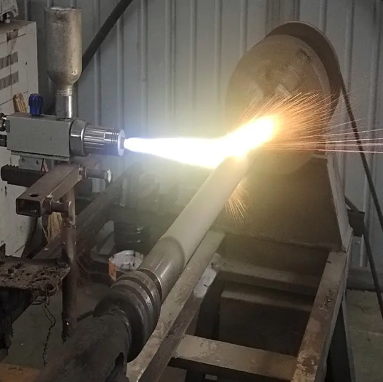
Spray welding behaves differently from joint-based welding. It focuses on surfaces. Traditional methods focus on joining parts. Each approach solves a different problem.
MIG welding joins metals by melting both the wire and the base material. It delivers high heat into the joint, which works well for structural connections. Spray welding behaves differently. It heats only the coating material, not the substrate. This keeps thermal stress low and helps protect thin, machined, or already finished parts from distortion.
The bonding method also sets them apart. MIG welding creates a full fusion weld where materials mix completely. Spray welding builds the surface layer by layer as molten particles impact and solidify. In fusion spray applications, light remelting creates partial metallurgical bonding, improving adhesion while avoiding deep heat penetration.
| Application | Spray Welding | MIG Welding |
|---|---|---|
| Surface repair | Yes | Limited |
| Structural joints | No | Yes |
| Wear protection | Excellent | Moderate |
| Thin components | Safer | Risky |
TIG welding focuses on precision and fine control. It creates narrow, clean weld beads and suits detailed joints or cosmetic work. Spray welding takes a different path. It covers wide areas fast and works better for large surfaces or worn components needing uniform buildup.
Material handling also differs. TIG performs best on clean, well-prepared metals and limited alloy combinations. Spray welding handles mixed alloys more easily. It coats steel, stainless steel, nickel alloys, and aluminum without strict joint preparation.
Cost and skill requirements separate them further. TIG welding demands experienced operators and longer training time. Spray welding trains faster, runs simpler setups, and keeps equipment investment lower overall.
| Factor | Spray Welding | TIG Welding |
|---|---|---|
| Operator skill | Moderate | High |
| Surface coverage | Large | Small |
| Heat distortion | Low | Higher |
| Speed | Fast | Slow |
Brazing, hardfacing, and spray welding all modify surfaces, but they bond in different ways. Brazing relies on molten filler flowing into joints without melting the base metal. Hardfacing melts filler directly into the substrate, forming a strong fusion layer. Spray welding builds the surface by stacking bonded particles. In fusion spray processes, light remelting improves metallurgical bonding while limiting heat input.
Wear performance also varies. Hardfacing produces thick overlays designed for heavy impact and extreme abrasion. Spray welding controls coating thickness more precisely. It delivers strong resistance to wear and erosion without excessive buildup or distortion.
Their use cases differ as well. Brazing fits assembly and joining tasks. Hardfacing works best in high-impact zones such as crusher parts. Spray welding excels in repair and rebuild work, restoring dimensions and surface performance efficiently.
| Process | Best Use |
|---|---|
| Brazing | Light assemblies |
| Hardfacing | Extreme wear |
| Spray welding | Surface restoration |
Spray welding delivers more than surface protection. It improves durability, controls costs, and keeps critical components in service longer across many industries.
Spray welding matters because it protects functional surfaces while preserving the original structure and accuracy of the base material.
Spray welding concentrates heat on the coating material rather than the substrate. The base metal remains relatively cool, so distortion stays minimal. This makes it ideal for thin components, precision shafts, and parts requiring tight dimensional control.
During application, molten alloy particles impact the prepared surface and fuse together while anchoring into the roughened substrate. This creates a dense, durable bond capable of handling rotation, pressure, and repeated mechanical stress in demanding environments.
Spray-welded coatings protect surfaces from abrasion, erosion, and chemical exposure. They form a barrier against moisture and corrosive agents, helping components maintain performance even in harsh industrial conditions.
Spray welding restores lost material on worn surfaces, bringing parts back to their original dimensions. It works well for sealing areas, bearing surfaces, and contact zones, allowing manufacturers to reuse valuable components instead of replacing them.
| Advantage | How Spray Welding Helps |
|---|---|
| Reduced Material Waste | Applies material only where needed. Less filler, less machining, less scrap. |
| Lower Repair and Replacement Costs | Restores parts instead of replacing them. Faster repairs reduce downtime. |
| Extended Component Lifespan | Coatings slow wear and fatigue. Parts stay in service longer. |
| Improved Production Efficiency | High deposition rates speed repairs. Fits existing shop workflows easily. |
Heavy industries rely on spray welding to restore critical surfaces and reduce downtime.
Rotating shafts and rollers experience constant friction and load. Spray welding rebuilds worn diameters and damaged surfaces without replacing the entire component. It keeps alignment intact and reduces machining time.
Valves operate under pressure, heat, and corrosion. Spray-welded coatings restore sealing faces and improve resistance to erosion. They help valves close tightly again, extending service life.
Bearing journals require smooth, accurate surfaces. Spray welding rebuilds worn journals to original size, followed by light machining. It prevents vibration, uneven wear, and premature bearing failure.
These industries demand precision, lightweight solutions, and repeatable quality.
Spray welding repairs high-value parts such as housings, shafts, and landing system components. It restores geometry without excessive heat, protecting surrounding material properties.
Thin or lightweight parts deform easily under traditional welding heat. Spray welding applies protective layers while keeping thermal impact low. It preserves strength and dimensional accuracy.
Automotive and aerospace components often fail due to surface wear, not structural damage. Spray welding rebuilds those surfaces, allowing tight tolerances to return after finishing.
Spray welding fits naturally into modern fabrication and forming workflows.
Formed tubes face abrasion, corrosion, and thermal cycling. Spray-welded coatings protect bends, joints, and contact zones, improving durability in service.
Bending dies, guides, and forming tools wear quickly under repeated cycles. Spray welding adds hard, wear-resistant layers, reducing tool change frequency and downtime.
Spray welding supports CNC wire forming by extending tool life and maintaining consistent forming quality. It helps tooling handle high-volume production without frequent rework.
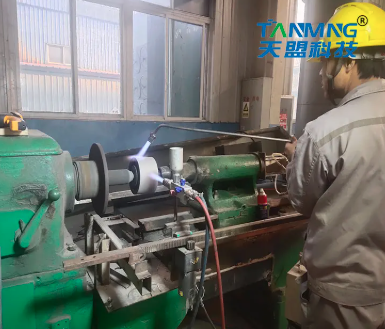
Spray welding fits situations where surface performance matters more than structural strength. It focuses on restoration, protection, and controlled heat input.
Rebuilds worn shafts, journals, and sealing surfaces
Restores dimensions without replacing the entire part
Keeps base material intact and limits thermal stress
Adds abrasion- and corrosion-resistant coatings
Works well on rollers, valves, and tooling surfaces
Controls coating thickness for consistent performance
Uses low heat input during deposition
Preserves shape on thin or finished components
Supports tight tolerance and precision parts
A: Spray welding belongs to the thermal spray family. It deposits heated particles onto surfaces. Some spray welding variants include a fusing step. That step improves bonding strength.
A: Spray welding creates strong surface bonds. It does not match full fusion weld strength. Traditional welding remains stronger for load-bearing joints.
A: No. Spray welding focuses on surface buildup and repair. Structural joints require full-penetration fusion welding methods.
A: Typical coatings range from 0.010 to 0.080 inches. Thickness depends on alloy, process, and application needs.
A: Yes, when using proper alloys. Many spray coatings handle heat, wear, and oxidation well.
Spray welding offers a practical way to rethink maintenance, repair, and surface protection. It focuses on restoring performance where damage actually happens, not replacing entire components. By limiting heat input and controlling coating thickness, it helps manufacturers save time, reduce waste, and keep critical parts working longer in real-world conditions.
At Jinan Tanmng New Material Technology Co., Ltd., we apply spray welding to solve everyday industrial challenges. From worn shafts to high-wear tooling, our team helps you choose the right materials and processes for reliable, cost-effective results. Ready to improve how your components perform? Let’s talk.


