
Views: 0 Author: Site Editor Publish Time: 2025-11-12 Origin: Site


Thermal Spray Equipment has emerged as a cornerstone technology for industries that aim to maximize the lifespan and performance of critical components. At Jinan Tanmng New Material Technology Co., Ltd., we specialize in designing and manufacturing advanced thermal spraying systems capable of handling a wide range of applications across multiple industries. These systems enable businesses to apply high-performance coatings to surfaces, enhancing wear resistance, corrosion protection, high-temperature durability, and electrical insulation. By transforming coating materials into a molten or high-velocity state and applying them precisely to components, thermal spray technology offers solutions to some of the most persistent challenges faced by industrial operators. Industries from heavy manufacturing to medical device production are increasingly relying on these advanced processes, and our portfolio—spanning flame, plasma, and supersonic spraying equipment—ensures precise, repeatable, and industry-proven results for every application.
The importance of Thermal Spray Equipment extends beyond simple surface enhancement. It addresses key operational challenges such as maintenance downtime, equipment replacement costs, and product reliability. This article explores how different industries leverage thermal spray technology, highlighting typical applications, process benefits, and measurable outcomes that demonstrate the tangible impact of our systems.
Heavy industries, including mining, steelmaking, and petrochemical production, operate under extreme conditions where wear, corrosion, and mechanical stress are daily challenges. Equipment failures in these sectors can result in significant financial losses due to production downtime and high repair costs. Thermal spray technology provides a practical and effective solution to enhance component durability and performance.
Mining operations and steel manufacturing subject machinery to abrasive materials, high impact loads, and extreme thermal cycles. Components such as rollers, molds, conveyor parts, and shafts often wear out rapidly, requiring frequent replacement or maintenance. This not only disrupts production schedules but also increases operational costs significantly.
Using our supersonic thermal spray equipment, Tanmng can deposit dense, wear-resistant coatings on critical surfaces. Materials such as tungsten carbide, chromium carbide, and nickel alloys are applied to create a hard, uniform layer that resists abrasion and extends component life. For example, steel mill rollers coated with supersonic-sprayed tungsten carbide have demonstrated a lifespan increase of more than 2.5 times, reducing downtime and saving costs associated with frequent part replacements.
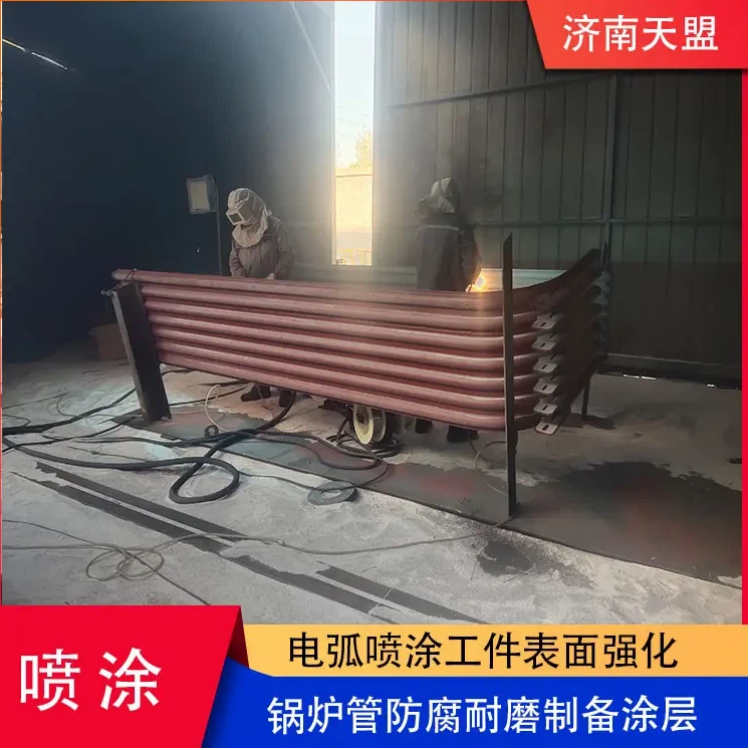
The flexibility of thermal spray processes also allows engineers to tailor coatings to specific wear patterns, ensuring maximum protection in high-stress zones. In addition, our modular arc spraying systems enable large-scale coverage for heavy components without compromising coating consistency or adhesion.
Offshore oil platforms, pipelines, chemical storage tanks, and refineries are continually exposed to corrosive agents such as saltwater, acids, and industrial chemicals. Traditional protective measures like paints or passive coatings often fail under prolonged exposure to these harsh conditions, leading to structural damage and costly repairs.
Thermal spray equipment, particularly arc and plasma spray systems, can apply corrosion-resistant coatings such as zinc-aluminum alloys, copper, and specialized ceramics. These coatings form a durable barrier that prevents corrosion and extends the operational life of critical infrastructure. For instance, offshore pipeline sections coated using Tanmng’s plasma spraying systems have demonstrated corrosion resistance improvements of over 40%, with maintenance cycles extended significantly.
Moreover, thermal spraying allows for precision coating of complex geometries, including curved surfaces, joints, and fittings, where conventional coatings often fail. This ensures consistent protection across all critical components, safeguarding assets and reducing maintenance costs over the long term.
The application of thermal spray coatings not only prevents wear and corrosion but also improves operational efficiency. By extending component lifespan, industrial operators can schedule maintenance proactively rather than reactively, avoiding unexpected downtime. In high-volume production environments, this translates to significant cost savings and uninterrupted production cycles.
In aerospace and power generation, components face extreme thermal and mechanical stresses. Turbine blades, combustion chambers, and heat exchangers operate at temperatures that can exceed the tolerance of most metals. Thermal spray coatings offer a reliable solution to enhance thermal performance, reduce oxidation, and extend component service life.
Gas turbines, jet engines, and industrial combustion systems demand materials capable of withstanding high temperatures while maintaining structural integrity. Thermal barrier coatings (TBCs), applied via plasma or supersonic spray systems, insulate underlying metal substrates, reducing thermal fatigue and oxidation.
For turbine blades, the use of ceramic TBCs allows engines to operate at higher temperatures without compromising safety. This leads to improved fuel efficiency, reduced emissions, and longer maintenance intervals. Tanmng’s high-energy plasma spraying systems ensure uniform deposition of TBCs, achieving consistent thickness, density, and adhesion. By precisely controlling the spray parameters, manufacturers can optimize the thermal insulation performance of each component, enhancing overall system efficiency.
Aerospace and power generation industries require rigorous quality control and traceability to comply with strict regulatory standards. Tanmng’s thermal spray equipment integrates advanced monitoring systems that track critical parameters such as coating thickness, deposition rate, and material characteristics in real time. This ensures repeatable results for high-value components and enables traceability for audit purposes.
The ability to maintain strict process control is particularly important for components subjected to cyclic thermal and mechanical loads. By ensuring coating consistency and adherence, our systems reduce the risk of premature failure, enhance reliability, and contribute to operational safety.
Implementing thermal spray technology in aerospace and power generation not only improves component performance but also provides economic advantages. Reduced maintenance frequency, extended service intervals, and minimized risk of unplanned shutdowns translate directly to cost savings. These benefits make thermal spray coatings an indispensable technology in high-performance engineering sectors.
The automotive and transportation industries demand high-performance coatings to enhance the durability of engines, transmissions, braking systems, and other moving components. Thermal spray equipment allows manufacturers to address issues such as friction, wear, and heat-related degradation efficiently.
Cylinder liners and pistons are exposed to constant friction and pressure, which can lead to premature wear and reduced engine efficiency. By applying wear-resistant coatings using flame or plasma spray equipment, manufacturers can extend component life, reduce maintenance costs, and improve fuel efficiency.
Thermal spray technology also enhances fuel system components, such as injection nozzles and pump parts, by reducing erosion and corrosion. Our high-precision equipment ensures uniform coating thickness and adhesion, which is crucial for components that operate under high pressure and temperature conditions.
Friction surfaces, including brake discs and clutch components, benefit from thermal spray coatings that provide wear resistance and heat tolerance. By improving the surface properties, these components maintain performance over extended operating periods, enhancing safety and reliability.
Thermal spray coatings reduce the frequency of part replacement and maintenance, directly impacting the total cost of ownership for automotive manufacturers and fleet operators. Longer-lasting components also contribute to improved vehicle performance, efficiency, and customer satisfaction.
Medical devices and electronic components require coatings with strict tolerances, biocompatibility, and electrical insulation. Thermal spray technology offers solutions that meet these exacting standards, enabling manufacturers to achieve both functional and regulatory compliance.
Orthopedic implants, dental prosthetics, and cardiovascular devices benefit from biocompatible coatings such as hydroxyapatite, titanium oxide, and other ceramics. Thermal spray equipment allows precise deposition of these coatings, enhancing implant integration and durability. For instance, plasma-sprayed hydroxyapatite coatings improve bone growth and reduce the risk of implant loosening.
In electronics, thermal spray technology is used to apply ceramic insulation layers, protecting sensitive components from heat, moisture, and corrosion. By controlling coating thickness and uniformity, manufacturers can ensure consistent electrical performance, enhance reliability, and extend product lifespan.
The flexibility of Tanmng’s thermal spray equipment allows customization of coatings for specialized medical and electronic applications. Our systems provide precise control over deposition rate, spray distance, and particle velocity, enabling tailored solutions for complex component geometries.
Selecting the ideal thermal spray equipment depends on application requirements, part size, coating materials, and production volume. Heavy industry applications often benefit from high-capacity modular spray lines capable of handling large components efficiently. Aerospace and medical sectors prioritize precision, requiring robotic-ready or computer-controlled plasma spray systems. Tanmng’s solutions offer both turnkey and customizable platforms, ensuring optimized coating performance regardless of component complexity.
Our robotic-ready configurations support complex geometries and tight tolerances, while high-volume modular systems provide rapid processing for large components. By aligning equipment capabilities with industry-specific challenges, manufacturers can achieve superior coating quality, longer component lifetimes, and measurable operational improvements.
Across heavy industry, aerospace, automotive, and medical manufacturing, Thermal Spray Equipment from Jinan Tanmng New Material Technology Co., Ltd. delivers exceptional benefits, including wear resistance, corrosion protection, thermal performance, and precision coating applications. Our extensive portfolio—from flame spray units to high-energy plasma and supersonic spray systems—addresses the unique challenges of each sector, enhancing component reliability, reducing downtime, and lowering operational costs. For detailed consultations, tailored equipment demonstrations, or specialized project evaluations, contact us today to explore how our advanced thermal spray solutions can elevate your operations.
Q1: What industries benefit most from thermal spray equipment?
A1: Industries including heavy manufacturing, aerospace, automotive, power generation, and medical device production gain significant advantages from thermal spray technology.
Q2: Which thermal spray equipment is best for corrosion protection?
A2: Arc and plasma spraying systems are highly effective for corrosion-resistant coatings in petrochemical, offshore, and industrial applications.
Q3: Can thermal spray coatings improve engine performance?
A3: Yes. Flame and plasma spray coatings reduce wear on cylinder liners, pistons, and friction surfaces, extending engine lifecycle and improving efficiency.
Q4: Is thermal spray equipment suitable for medical applications?
A4: Absolutely. Plasma and supersonic spray systems can deposit biocompatible coatings for implants and precision electrical insulation layers.