
Views: 0 Author: Site Editor Publish Time: 2026-06-14 Origin: Site


Industrial equipment relies heavily on durable surfaces to survive harsh operating conditions. When components begin to wear down, engineers often search for the most robust protection available. A common misconception in industrial procurement is that "thicker is always better" for wear resistance. In reality, thermal spray coating thickness is strictly governed by the physics of residual stress.
This guide breaks down the engineering limits of thermal spray build-ups, examining how material selection and application methods dictate performance. We will explore why these boundaries exist and how to navigate them effectively. It provides a realistic evaluation framework for specifying thickness on critical industrial components—specifically an Industry Roller, Shaft Sleeve, and Doctor Blade—to balance wear life, dimensional accuracy, and risk of delamination. By understanding these parameters, you can engineer surfaces that perform reliably under the most demanding mechanical stresses.
Stress Limits: Thermal spray bonds are mechanical; excessive thickness traps residual stress, exponentially increasing the risk of cracking and delamination.
Process Constraints: Maximum thickness varies drastically by process—up to 0.250” (6.35mm) for Arc/Flame metals, but typically capped at 0.020” (0.5mm) for dense HVOF carbides.
Component-Specific Needs: An Industry Roller requires volume for wear/regrinding, a Shaft Sleeve needs precise dimensional restoration, while a Doctor Blade demands ultra-thin profiles to maintain edge geometry.
Machining Allowances: True functional thickness is achieved post-grinding; specifications must account for a tighter tolerance (e.g., ±0.001") after initial over-spraying.
To understand why we cannot simply spray infinite layers of material onto a part, we must look at how these coatings form at a microscopic level. The limits are not driven by machine capability but by fundamental physics.
During the application process, molten or semi-molten particles strike the substrate at high velocities. Upon impact, they flatten into thin discs called "splats" and rapidly freeze. This rapid quenching causes the material to contract. Because the splat is anchored to the substrate, this contraction generates tensile stress. As you build the coating layer by layer, this internal stress multiplies. Eventually, the accumulated stress will exceed either the cohesive strength of the coating itself or the adhesive bond it shares with the substrate.
Engineers must carefully balance density and porosity when designing a protective layer. Each characteristic interacts differently with internal stress:
Dense Coatings: Processes like High-Velocity Oxygen Fuel (HVOF) create highly dense, low-porosity layers. They offer superior wear and chemical resistance. However, their rigid, tight microstructures build stress rapidly. This stiffness strictly limits their maximum achievable thickness before cracking occurs.
Porous Coatings: Applications with higher porosity accommodate more structural stress. The microscopic voids act as shock absorbers, allowing for much thicker builds. They also hold lubrication well. Unfortunately, they provide weaker barriers against corrosive penetration, requiring sealers in wet environments.
When you exceed the engineering limits of a specific material, catastrophic failures occur. The three most common consequences of over-spraying include:
Cohesive Failure (Spalling): The coating fractures internally, causing large chunks to break away from the part.
Interface Delamination: The accumulated stress shears the mechanical bond at the substrate line, causing the entire layer to peel off cleanly.
Microscopic Crazing: Fine, spider-web-like cracks form across the surface. These cracks allow corrosive fluids to bypass the barrier and attack the base metal directly.
To safely increase the thickness of a hard topcoat, engineers often use an intermediate layer known as a bond coat. Metals like Nickel-Aluminum (NiAl) are common choices. They help manage the Coefficient of Thermal Expansion (CTE) mismatch between a steel substrate and a rigid ceramic topcoat. By acting as a ductile buffer zone, the bond coat absorbs thermal shocks and shear stresses, preventing premature interface delamination.
Maximum build depth varies wildly depending on the application technology. The following capability baselines represent typical engineering standards. Keep in mind that specific parameter tuning can slightly alter these limits, but they serve as a reliable foundation for initial design.
Arc and flame systems generally apply ductile metal alloys like stainless steel, zinc, or bronze. Because these materials are inherently flexible, they absorb internal stress remarkably well.
Maximum Limit: They can safely achieve thicknesses up to 0.250 inches (6.35 mm).
Primary BoF Use Case: This process is ideal for the aggressive dimensional restoration of heavily worn carbon steel parts, such as large bearing journals or structural housings.
These processes generate extreme kinetic energy or thermal energy to apply hard, dense materials. While they offer unmatched protection, their low ductility means stress accumulates quickly.
Maximum Limit: The typical functional benchmark for wear resistance is approximately 500 microns (0.020 inches). Pushing beyond this invites severe micro-cracking.
Primary BoF Use Case: Engineers use these systems for extreme abrasion and corrosion protection where dense, impenetrable microstructures are mandatory.
High-Velocity Air Fuel (HVAF) represents a shift in modern application techniques. It uses an air-fuel mixture instead of the oxygen-fuel mix found in HVOF. This results in cooler particle temperatures during transit.
Maximum Limit: Because the particles experience less thermal degradation and retain better ductility, HVAF can achieve thicker carbide buildups—up to 0.050 inches (1.27 mm)—without stress-fracturing.
Process Type | Material Category | Typical Max Thickness | Primary Application |
|---|---|---|---|
Arc / Flame Spray | Ductile Metal Alloys | Up to 0.250" (6.35 mm) | Heavy dimensional restoration |
HVOF / Plasma | Carbides & Ceramics | ~0.020" (0.5 mm) | Severe wear & chemical defense |
HVAF | Ductile Carbides | Up to 0.050" (1.27 mm) | High-impact wear resistance |
Specifications must shift based on the mechanical function of the part. A blanket approach to application depth guarantees failure. Let us examine three distinct industrial components to see how their unique operating environments dictate surface engineering.
In web handling and converting processes, an Industry Roller requires a delicate balance of traction, wear resistance, and occasionally non-stick properties. These massive cylinders handle abrasive paper, foils, or films at high speeds.
Thickness Strategy: These cylinders are often sprayed between 0.005" and 0.015". This allows sufficient material volume for final grinding. Achieving exact concentricity and a specific surface roughness (often 30 RMS or better) is critical for web alignment.
Composite Approach: Many rollers utilize a "peaks and valleys" technique. Technicians spray a hard carbide matrix to create durable peaks. They then impregnate the porous valleys with fluoropolymers like PTFE. This composite strategy yields a surface that is both highly wear-resistant and completely non-stick.
A Shaft Sleeve operates in incredibly harsh zones. It faces high friction from packing seals, localized abrasive wear, and constant exposure to corrosive fluids.
Thickness Strategy: The specification requires enough depth to act as a sacrificial wear barrier. However, it must strictly respect tight clearance tolerances inside the pump housing. Overbuilding here causes mechanical binding.
Risk Mitigation: Substrate temperature must be tightly controlled during application. It must remain below 250°C. If a thick build causes the component to overheat, metallurgical distortion occurs, warping the sleeve. Furthermore, high-porosity builds on these parts require epoxy or sodium silicate sealers to prevent corrosive fluids from undercutting the base metal.
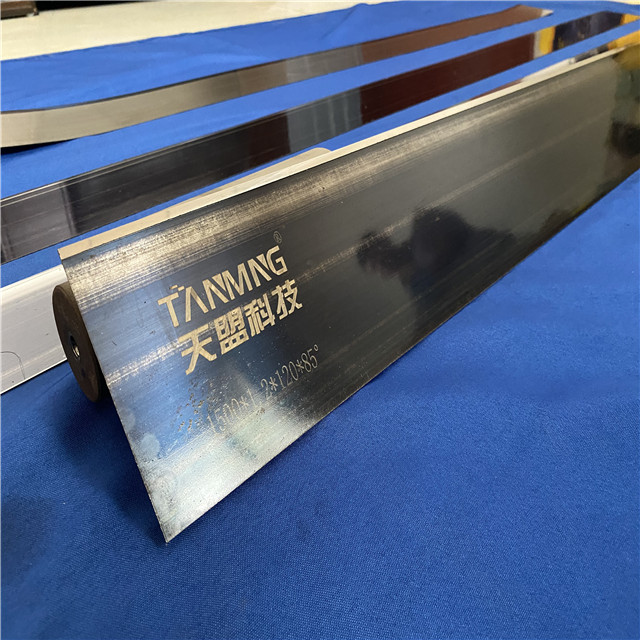
When engineering a Doctor Blade, absolute precision is the governing rule. Edge retention and minimal friction take priority over bulk mass.
Thickness Strategy: Unlike thick cylinders, blade edge protection must be highly restricted. They often require ultra-thin precision alternatives like PVD/DLC in the 1–5 µm range. If traditional methods are used, they involve highly specialized micro-thickness applications strictly on the bevel.
Performance Impact: A protective layer that is too thick on a blade rounds the cutting geometry. This increases drag and causes chatter against the mating surface. Conversely, if it is too thin, the abrasive web wears the blade down prematurely. Precision is non-negotiable here.
Specifying a dimension on a drawing is only the first step. Translating that number into reality requires rigorous process control. The gap between what comes out of the spray gun and the final polished dimension defines the success of the project.
You cannot simply hold a spray gun over a part and guess the depth. Rotational RPM, surface speed, and step-height parameters dictate the exact volume deposited in a single pass. If the automation moves too fast relative to the rotation, poor control leads to "barber's pole" spiral defects. This leaves a helix of high and low spots across the component.
Achieving your target depth requires aggressive thermal management. Because each pass adds intense heat, active cooling is mandatory. Technicians use compressed air jets or liquid CO2 directly on the part. This removes heat during successive passes without interrupting the application. Poor thermal management leads to immediate cracking as the part expands and contracts wildly.
Functional limits are rarely achieved straight out of the booth. You must account for multi-stage finishing.
As-Sprayed Allowance: The process always requires an "as-sprayed" allowance, typically targeting an overbuild of ±0.0025".
Final Grinding: The part is then ground or polished down to its "finished" functional depth. This step tightens tolerances to a strict ±0.001" per side.
Warning: Incorrect post-grinding of thick ceramic or carbide layers causes intense micro-cracking. Using the wrong diamond wheel feed rate will destroy the barrier entirely, regardless of how perfectly it was applied in the booth.
Clear communication between design engineers and application specialists prevents premature failures. Use this actionable checklist when formulating an RFQ or Project Specification.
Define Substrate Prep: Do not leave surface preparation to chance. Mandate aggressive surface profiling (such as aluminum oxide grit blasting). You must also specify the industry-standard "2-hour rule"—the layer must be applied within two hours of blasting to prevent invisible oxide formation on the steel.
Target the Application, Not the Maximum Limit: Specify the depth based on calculated wear rates and mating part clearances. Never ask for the maximum allowable build simply for "extra protection." Over-engineering this metric is the leading cause of delamination.
Specify Finishing Requirements First: Work backward from your final need. Clearly denote the final required dimension and the exact Ra/RMS surface finish. Explicitly state whether liquid sealers are required for your specific intended operating environment.
Demand NDT (Non-Destructive Testing): Trust but verify. Require liquid penetrant testing (PT) to check for microscopic surface cracks. Additionally, request bond strength testing on companion coupons sprayed alongside your actual part. This verifies structural soundness at your specified depth.
Optimizing application depth is fundamentally an exercise in structural balance. Over-engineering thickness wastes capital and invites catastrophic delamination due to trapped residual stress. Conversely, under-engineering leaves critical components vulnerable to premature wear and chemical attack.
By understanding the physical limits of different materials—from ductile metal alloys to rigid carbides—you can specify tolerances that actually enhance mechanical life. Always account for proper machining allowances and strict thermal control during application.
To ensure success, we strongly encourage procurement teams and mechanical engineers to engage with coating specialists early in the design phase. Aligning your substrate geometry, chosen process type, and post-machining capabilities from day one guarantees a surface that performs exactly as intended.
A: No. Because the bond is mechanical, spraying new material over a degraded, contaminated, or oxidized coating leads to immediate failure. The old coating must be completely stripped, the substrate re-profiled, and a new layer applied.
A: Typically ranges between 0.010" and 0.020" (250–500 microns), often paired with a sealer to close microscopic porosity and block chemical pathways to the substrate.
A: It usually does the opposite. As thickness increases, the accumulated residual stress puts more strain on the mechanical bond interface, lowering the overall bond strength compared to a thinner, stress-neutral layer.


